| 书目名称 | Chemically Induced Dynamic Nuclear and Electron Polarizations-CIDNP and CIDEP |
| 编辑 | Claude Richard,Pierre Granger |
| 视频video | http://file.papertrans.cn/225/224503/224503.mp4 |
| 丛书名称 | NMR Basic Principles and Progress |
| 图书封面 | 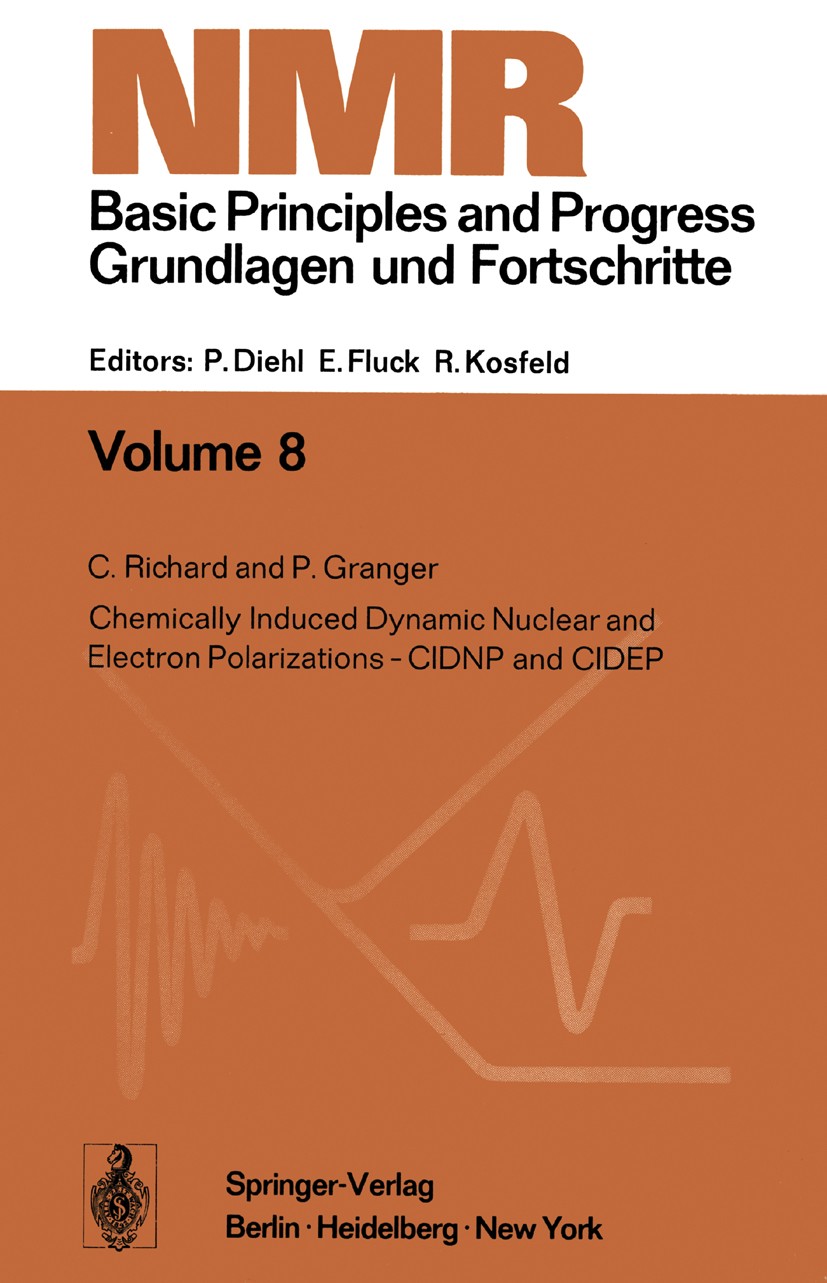 |
| 描述 | Anomalous electron-spin state populations in the Electron Paramagnetic Re sonance (EPR) spectra of radicals formed during radio lysis experiments were observed in 1963 by FESSENDEN and SCHULER [170a]. This phenomenon did not receive much attention at the time. In 1967, BARGON, FISCHER, and JOHNSEN [5] and independently WARD and LAWLER [7,8] reported a similar phenomenon for Nuclear Magnetic Resonance (NMR) spectra taken during radical reactions: emission or enhanced absorption, or both. The earliest attempts to explain this new NMR phenomenon treated these effects in a way similar to that of Dynamic Nuclear Polarization (DNP) or the Overhauser effect. Although the polarization has a completely different origin, DNP gave its name to this effect: Chemically Induced Dynamic Nuclear Polariza tion (CIDNP). [The name Chemically Induced Dynamic Electron Polarization (CIDEP) was introduced later by analogy with CIDNP]. After the initial publica tions, all the new data demonstrated that the first theory could not be correct. In 1969, a new theory was proposed by CLOSS [18] and independently by KAPTEIN and OOSTERHOFF [23] and called the radical-pair theory. This mechanism was proposed to |
| 出版日期 | Conference proceedings 1974 |
| 关键词 | Absorption; Atom; Diffusion; Elektronenpolarisation; Kernpolarisation; NMR; Nuclear; Nuclear Polarizations; |
| 版次 | 1 |
| doi | https://doi.org/10.1007/978-3-642-65793-1 |
| isbn_softcover | 978-3-642-65795-5 |
| isbn_ebook | 978-3-642-65793-1Series ISSN 0170-5989 |
| issn_series | 0170-5989 |
| copyright | Springer-Verlag Berlin · Heidelberg 1974 |
 |Archiver|手机版|小黑屋|
派博传思国际
( 京公网安备110108008328)
GMT+8, 2026-9-5 03:47
|Archiver|手机版|小黑屋|
派博传思国际
( 京公网安备110108008328)
GMT+8, 2026-9-5 03:47






 发表于 2025-3-21 19:39:18